

Introduction
In today’s highly competitive manufacturing environment, companies are constantly under immense pressure to minimize manufacturing costs, lower product delivery times, and manage complex supply chains while ensuring that the quality of manufactured parts is maintained or even enhanced. Many companies are using traditional CNC Turning Service Providers, only to realize that costs, quality, and communication delays are constantly affecting profit margins in a negative way.
This has been a major issue for many companies in the past, and the reason for this has been a fragmented approach to manufacturing processes. The manufacturing process has been in a silo, and there has been a lack of data-driven insights in business decisions. The traditional approach of using a single machine has been a major issue in this regard; this article explores how intelligent CNC turning strategies can be a major driver in ensuring that there is a comprehensive approach to cost optimization and efficiency improvements in the manufacturing process.
Where Are the Hidden Costs in Traditional CNC Turning Processes?
A conventional, low-bid approach to a CNC turning project usually only scratches the surface of a given project’s costs. Indeed, the greatest costs are often hidden from view, represented by inefficiencies not included in a standard bid. While a primary cost may be represented by a machining fee, additional costs are represented by design-induced waste in materials, as parts are not optimized, resulting in a larger billet size. Other costs come from secondary machining resulting from poor initial process planning. Yet, perhaps the greatest costs come from quality instability, represented by waste, rework, rush air freight charges, and line downtime from defective or late parts.
1. The Systemic Impact of Process Waste and Inefficiency
Inefficiency is a cost multiplier. A process that doesn’t utilize optimized cutting parameters is a waste of energy and a precursor to cutting tools deteriorating prematurely. A production schedule that doesn’t utilize planning correctly results in machine down-time and excessive inventory in the works-in-progress pipeline. The administrative costs associated with managing a supply chain that’s fragmented into multiple vendors for each process step in a machine’s life — turning, milling, finishing — is a significant waste in its own right. As studies on U.S. Office of Energy Industry Technologies point out, a systemic analysis of the entire manufacturing process is necessary to identify these wastes that contribute significantly to total costs.
2. Quantifying the Cost of Poor Quality and Delays
The cost of quality issues is exponential in nature. A single batch of substandard parts, for instance, could snowball into a variety of costs, from the parts themselves to labor costs, to expedite replacement parts, and to compensate for delayed delivery schedules. More alarmingly, a substandard part failure in service could culminate in warranty claims, brand erosion, and erosion of customer trust. A supplier with an absence of processes and statistics is, by default, a higher risk premium, resulting in an unpredictable and, in many instances, a higher overall cost to the buyer over the life of a project.
3. Building a Foundation for Transparent Cost Analysis
Thus, a genuine cost assessment is a “forensic and holistic” effort, one that must “look beyond the price per unit to truly comprehend the drivers of total costs in the manufacturing ecosystem.” This means, for instance, examining “the supplier’s technology, quality management, and operations discipline.” It is by addressing such “hidden costs of waste, inefficiency, and quality risk” that a manufacturer moves from “cost cutting” to “cost effectives” and so provides a “foundation for sustainable cost savings.”
How Can Digital Thread and Smart Process Optimization Slash Waste?
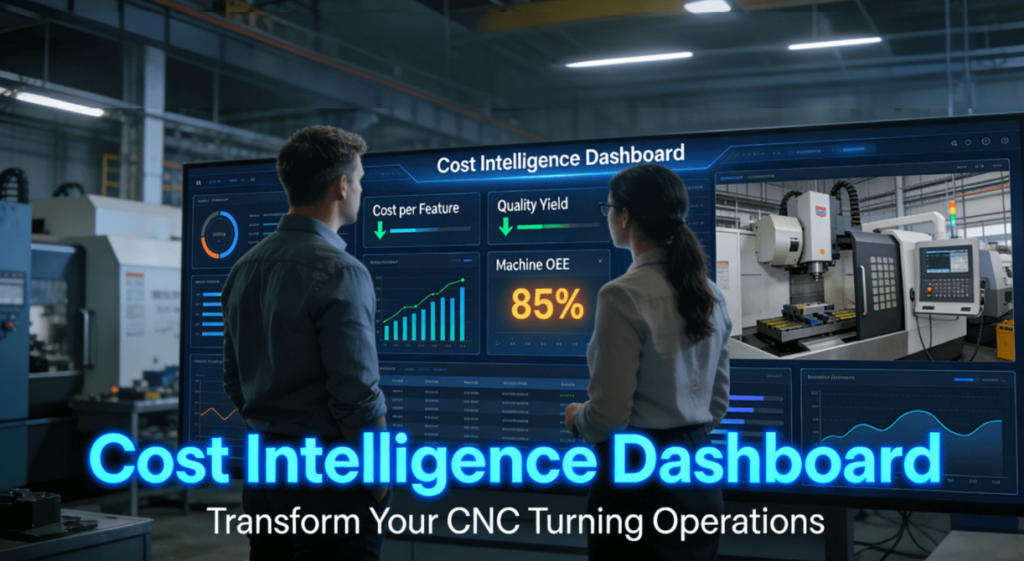
The digital thread, or the unbroken flow of data from CAD design to finished part, is the “central nervous system of intelligent manufacturing“, enabling unprecedented reductions in waste. It starts with virtual design for manufacturability, where computer-aided design software simulates a part’s machining to detect and remove unnecessary features that lead to material waste, special tooling, or longer processing times. This upfront optimization of a design for efficient manufacturing reduces costs in both raw materials and processing time.
- Leveraging Data for Predictive and Adaptive Control: Smart processes utilize real-time data to optimize all cuts. IoT devices installed in machine tools measure spindle load, vibration, and temperature. This information is then processed by the system to forecast when the cutting tool needs to be replaced before it compromises the dimensions of the parts. Adaptive control systems can be employed to change the feed rates according to the actual cutting process. This prevents the cutting tool and parts from being damaged while maximizing metal removal rates. This predictive approach to maintenance reduces downtime and increases the lifespan of the equipment.
- The Role of Advanced Simulation and Digital Twins: Before a single chip is made, the entire process is perfected in a digital environment. Advanced CAM software with simulation capabilities allows for a digital twin of the machining process to be created, ensuring that the process is both collision-free and efficient. This allows for various scenarios to be simulated to determine the most cost-effective solution for the project. This is a key driver in the Digital Transformation of manufacturing processes, ensuring that the first part is made correctly and that the associated costs are minimal.
- Implementing a Cohesive Optimization Strategy: This digital-physical integration is the key to true efficiency in the process. It allows for a series of machining operations to be integrated into a cohesive system that is optimized for success. A comprehensive understanding of the entire CNC Turning process is necessary for this integration to be achieved. A wide range of resources that discuss the various aspects of precision CNC turning services is necessary for a true grasp of this process and its implementation in a digital environment.
What Role Does Multi-Axis and Mill-Turn Technology Play in Consolidation?
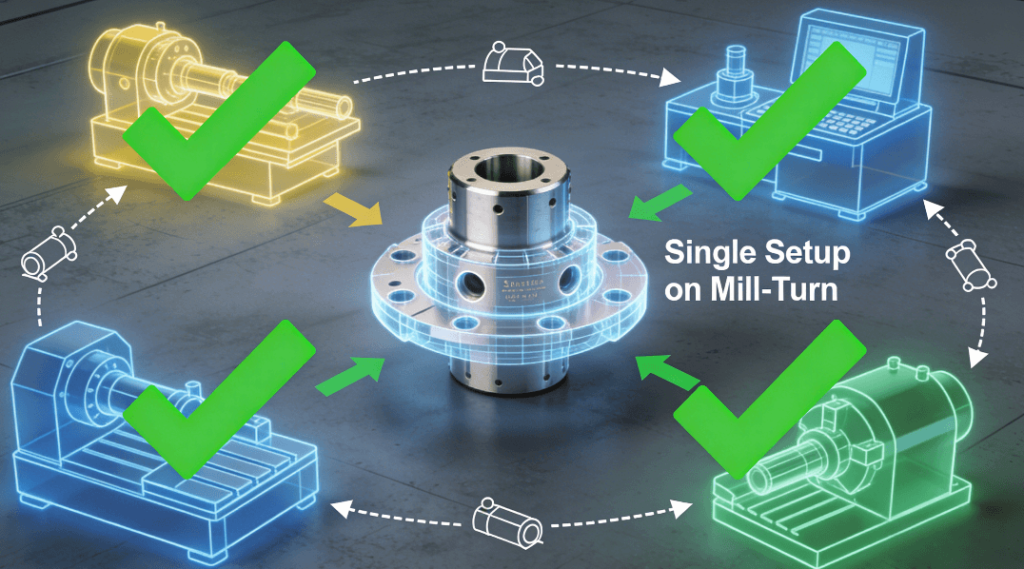
Multi-axis and mill-turn CNC machines really push the consolidation process forward. How? Because a single operation in these machines can replace the whole multi-operational, multi-machine sequence. For instance, a complex part like a housing with hole offsets flats grooves may need different operations on a lathe, milling machine, and drill press in a traditional machining process. Each time you change operation, you would have to set up the fixture again, re-qualify the datums, and the handling of parts might cause damage. On the other hand, a mill-turn machine equipped with live tooling and a Y-axis is capable of accomplishing the greatest part of the features in one single operation, while the part is tightly clamped in the machine.
1. The Precision and Efficiency Dividend of Single-Setup Machining
The single most important advantage of mill-turn machining technology is the absence of accumulation of errors. By machining all critical features relative to a single, unchanged datum, mill-turn machining technology ensures unparalleled geometric relationships between turned diameters, milled flats, and drilled holes. In addition, mill-turn machining technology eliminates non-value-added time in several ways. There is no time spent waiting for the next available machine, no time spent queuing for secondary operations, and minimal parts handling.
2. Enabling Design Innovation and Part Count Reduction
This technological capability enables design innovation. It now becomes possible for engineers to design more monolithic parts, or parts that integrate what was previously an assembly of multiple parts. This part count reduction eliminates the need for fasteners, reduces inventory complexity, and provides greater structural integrity. It also reduces potential failure points. The ability to create complex, off-axis features also enables topology-optimized parts, or parts that only utilize material in the structure. The benefits of multi-axis turning are now felt from the factory floor all the way to the functionality and cost of the parts.
3. A Strategic Investment in Manufacturing Agility
Thus, the implementation of mill turn technology is a strategic investment in fundamental Manufacturing Efficiency. Although a considerable investment in hardware is required, it is an investment in dramatically lower cost per feature, fixture inventory, and space, and in responding to engineering change requests. To manufacturing companies, this means the ability to make smaller batch sizes and more complex custom parts profitably, and thus it is a fundamental strategy for companies that must compete on innovation, quality, and speed in a world of high mix, low volume manufacturing.
Why is a Holistic Quality Control System Non-Negotiable for Cost-Effectiveness?
In precision manufacturing, quality is not a cost center; it is the most powerful lever for cost avoidance. The financial engine for cost-effective and reliable production is a holistic preventive quality system. The adage “quality is free” was never truer than now, provided that defects are not inspected out at the end of the process but rather prevented from the outset. A quality system based on statistical process control, mistake-proofing, and first-article validation guarantees that good parts are made every time, thereby eliminating the enormous cost of scrap, rework, sorting, and warranty claims.
1. The Financial Architecture of Prevention
When a company has a certification for its Quality Management System, it is like laying down the main architectural groundwork for establishing a prevention system. Achieving a standard such as ISO 9001, IATF 16949 (automotive), and AS9100D (aerospace) entails the adoption of a process approach. This means, among other things, carrying out risk analysis (FMEA), control planning, and maintaining total traceability. In effect, all the variables, right from the elemental composition of raw materials to the measuring instrument calibration, are thoroughly controlled. Collaborating with a business that holds certifications of these standards is a kind of insurance against the risk of a severe quality failure that might disrupt the project and lead to unexpected costs.
2. Data-Driven Quality and Continuous Improvement
Quality today is a data-driven discipline. The probing and measuring that happens during the process on a CMM machine provides a constant stream of data. This data is not just for making go/no go decisions; it is also being analyzed to look for trends that will help us achieve predictive quality and continuous improvement. This shift from detection to prediction and prevention constitutes the very essence of the Industry 4.0 Quality Movement—also known as “Quality 4.0″—as defined by the Society of Manufacturing Engineers (SME).
3. Quality as a Strategic Supply Chain Advantage
Thus, a quality system is an essential part of supply chain optimization. It provides the predictability and reliability that enables us to have lean inventory levels and just-in-time delivery. It eliminates the need for the buyer to do internal inspections and provides a level of trust that is essential for a successful business partnership. A manufacturing partner that has a deeply ingrained quality culture that is demonstrated by having the best quality ratings and a data-driven approach is not just a supplier of parts; they provide a level of certified consistency that is a non-negotiable requirement for achieving Cost-Effectiveness in our business.
How to Build a Resilient and Cost-Effective Supply Chain with the Right Partner?
The new efficiency in the volatile world market is resilience. No longer is building a cost-effective supply chain about finding the lowest-cost supplier, but rather building a partnership that will reduce risk and increase mutual value. A transactional partnership is one that is only focused on unit cost, often at the expense of transparency and communication. A strategic partner is one that is integrated as an extension of your engineering and operations team.
- The Value of Engineering Collaboration and Transparency: The single most valuable contribution of a partner is during the design phase. A partner that offers proactive “Design for Manufacturability” analysis can recommend changes that drastically cut the effort and cost of machining, material, and assembly. Collaboration and openness in their pricing will create trust and make sure both parties aim at the same ultimate goal: total cost optimization. Such collaboration will turn your supplier from a simple order-taker into a key player in your company’s success and profitability.
- Ensuring Flexibility and Scalability: A resilient partner should be able to align with your changing needs and production capacity. They should be capable of supporting low-volume prototyping for quick iterations, as well as handling high-volume production without compromising the product quality and without the need to change their processes. This “prototype to production” adaptability will help incorporate the lessons learned during prototyping into the production phase, thereby avoiding costly redesigns. On top of that, a partner with access to diversified manufacturing bases and logistics will be more resilient against disruptions like raw material shortages, logistics difficulties, and unexpected demand fluctuations.
- Partnering for Long-Term Competitive Advantage: Therefore, the selection of the right manufacturing partner is one of the key factors in strategic sourcing. Ideally, you should partner with a person whose capabilities, skills, and culture will support your need for supply chain resiliency and total cost management. The solution is simple: cooperating with a highly integrated CNC turning parts manufacturer is a step towards your company’s future – a future that is more agile, more predictable, and more cost-effective.
What Does a Truly Transparent and Optimized CNC Turning Pricing Model Look Like?
The optimized, transparent CNC turning pricing model is the embodiment of a highly advanced and sophisticated business model, one that extends far beyond the simple “price per part” to include a justified and well-understood methodology for creating value and managing cost. This is not a model built on estimates, but one built on hard data. It includes scientifically determined machining times, not generic “hours.” It includes accurate and precise measurements of the cost of the raw billet, as well as the efficiency of the nesting or cutting method.
1. Deconstructing the Cost Drivers
A clear quote not only prices but also educates. It clearly articulates the cost of programming and setup, which is fixed and amortized by the batch. It clearly articulates the tooling consumption and maintenance costs, again based on the material to be cut. It clearly articulates the quality assurance cost, which includes in-process inspection, CMM reporting for the finished part, and potentially material certification. It clearly articulates the post-processing and packaging and logistics costs.
2. Aligning Price with Value and Risk
In an optimized model, price is aligned with capability and risk. A supplier with the best machine capability and the expertise to run those machines at the highest efficiencies may charge a premium machine hour rate but deliver the part in half the time with zero scrap. A supplier with a certified quality system that uses data to drive decisions includes the cost of prevention, which is a fraction of the cost of failure for the customer. The model shows that the lowest risk and most reliable approach to making the part may not be the least expensive on a per part price but is actually the least expensive from a cost of ownership perspective.
3. Fostering a Partnership Based on Mutual Success
A transparent pricing model, therefore, represents a foundational aspect of a true partnership. This is because it transforms a relationship from an adversarial negotiation of margin to a cooperative effort to maximize total system costs. This enables both parties to recognize costs and work cooperatively to minimize them. In exchange for requiring such a level of pricing transparency and strategy, manufacturers are able to position themselves to make sourcing decisions that truly benefit them.
Conclusion
To obtain a 20% or greater cost reduction in precision manufacturing, it is not merely a matter of intense price negotiations, but rather a comprehensive approach that incorporates intelligent strategies, which is achieved by harnessing the power of digital transformation to reduce process wastes, deploying advanced multi-axis technology to reduce manufacturing steps, investing in a culture of preventive quality, and developing strong supplier relationships that provide transparent value and engineering collaboration. By transforming the manufacturing supply chain from a cost focus to a value focus, manufacturing leaders are able to build a sustainable competitive advantage to succeed in today’s challenging market environment.
FAQs
Q1: What is the most significant factor that is usually not given due importance while determining the cost of CNC turning?
A: The most significant factor that is not given due importance is the total cost of ownership, including the “cost of quality” (scrap, rework, and delays) and supply chain management costs. A lower unit cost may not reflect the total cost. A company with good systems and certifications may be able to deliver at a lower total cost because of their reliability, consistency, and timeliness.
Q2: Is there room for digital transformation in small to medium batch production?
A: Absolutely, digital technologies are extremely valuable in low to medium volume production. Digital technologies, like digital process planning and simulation, can prevent mistakes before production. They can optimize machine performance, even in short-run production, with IoT machine monitoring. They can also provide transparency with cloud-based project management.
Q3: How does the multi-axis mill-turn technology improve part quality in particular?
A: The quality improvement comes from the elimination of workpiece rehandling. The traditional process requires multiple steps and, consequently, re-fixturing, which leads to cumulative errors in workpiece alignment. The major advantage of the mill-turn process is that it ensures superior positional accuracy and perfect concentricity between all work features in a workpiece. This gives better quality in parts, especially in aerospace and medical device applications.
Q4: What should I expect to see in a quality control report from a precision machining supplier?
A: A quality control report should include a very detailed first article inspection report with actual measurements versus drawing; a material certification report; statistical process control charts for critical dimensions; traceability to material batch and machine data; and a Certificate of Conformance. More advanced suppliers will also include 3D scan deviation maps and Cpk data to demonstrate their control of processes.
Q5: Is it more cost-effective to get prototypes and production from the same supplier?
A: A smooth ‘Prototype to Production‘ process with a single supplier is definitely cost-effective. This is because the knowledge gained in the manufacturing process during the prototyping stage can be leveraged in the production stage with the same supplier. This way, costly redesigning for manufacturability is avoided in the later stages.
Author Bio
This article is informed by the significant and real-world experience of precision manufacturing experts dedicated to ensuring operational excellence and cost optimization in global supply chains. If you are a team that wants to take a closer look at the cost structure of CNC turning operations and create a a more robust value-based supply chain, a process review is a recommended next step. LS Manufacturing is a certified precision manufacturing partner that leverages intelligent process strategies, digitalization, and a collaborative partnership approach to deliver significant cost savings for clients while ensuring high standards of quality and reliability in mission-critical industries.
