

Running a charity in the UK has never been easy. Between rising costs, growing demand for services, and the constant challenge of keeping donations flowing, most charitable organisations are stretched thin. The people behind these charities are passionate about their causes, but passion alone does not pay for the staff, the programmes, the facilities, and the outreach that vulnerable communities depend on. Money does.
And finding reliable, sustainable sources of income is one of the biggest challenges any charity faces.
This is where clothing donations come in. And more specifically, this is where choosing the right partner to manage those donations makes all the difference. We Recycle Clothes has been working alongside UK charities for over 15 years, helping them turn donated clothing into a consistent, dependable revenue stream.
But what makes this particular model worth paying attention to? And why are charities across the country choosing to work with We Recycle Clothes rather than relying solely on traditional donation routes?
The Problem with Traditional Clothing Donations
Let’s start with an honest look at the situation most charities find themselves in. When members of the public want to donate clothes, their first instinct is usually to drop bags at a charity shop. This is a generous and well intentioned act, and charity shops have been a lifeline for many organisations for decades. But the reality on the ground is more complicated than most people realise.
Charity shops need space to receive, sort, price, and display donated items. They need staff and volunteers to manage the process. They need footfall to sell the goods. And they need all of this to happen consistently, week after week, to generate meaningful income. When donations arrive faster than they can be processed, or when shops are already full, the system breaks down. Items pile up in stockrooms. Sorting backlogs grow.
And in some cases, charities are forced to turn donations away or pay to have excess stock removed, which actually costs the charity money rather than generating it.
For smaller charities, the challenge is even more acute. Not every organisation has a network of high street shops. Not every charity has the infrastructure, the volunteers, or the budget to run a retail operation. Yet these charities still need income. They still need funding to deliver the services their communities depend on. And they still need a way to benefit from the enormous volume of unwanted clothing that the UK public is willing to give away.
How We Recycle Clothes Solves This
We Recycle Clothes offers a fundamentally different approach. Rather than asking charities to manage the entire donation chain themselves, the company handles everything. Collection, sorting, resale, and payment. The charity’s role is simply to be the chosen beneficiary. Everything else is taken care of.
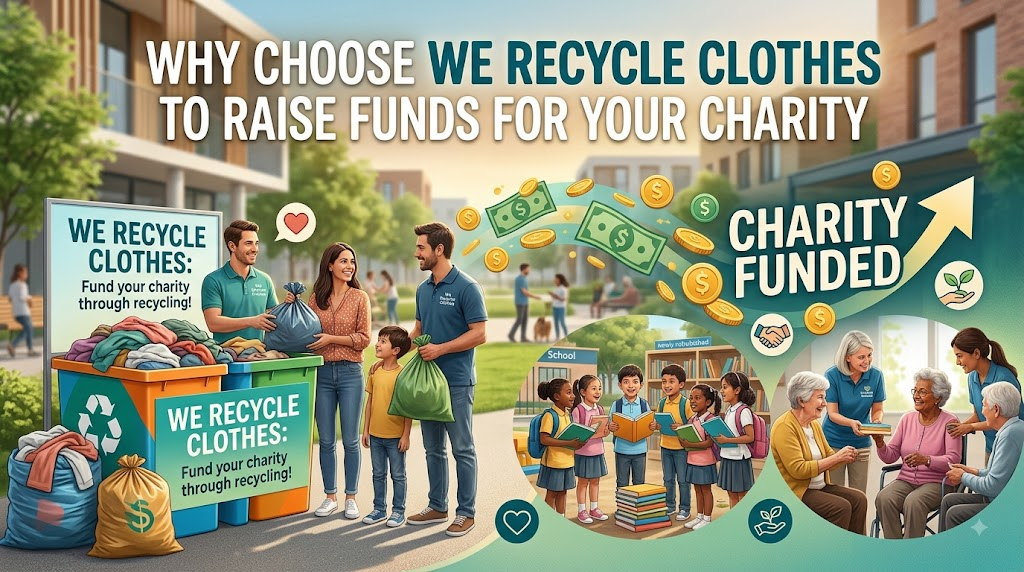
Here is how it works in practice. Members of the public visit werecycleclothes.org.uk and book a free clothes collection. They choose the charity they want to support from a list of trusted partners, bag up their unwanted clothes, shoes, accessories, and household items, and leave them at their door on collection day. We Recycle Clothes picks up the bags, sells the items through their resale network, and passes the proceeds to the chosen charity.
Every tonne of donated clothing generates a minimum of £200 for the charity.
There is no cost to the charity at any stage. No collection fees. No processing charges. No administrative burden. The charity receives cash, not bags. And that cash goes directly toward funding the work that matters most.
Why This Model Works for Charities
The strength of this model lies in what it removes from the charity’s plate. Running a successful clothing donation programme requires logistics, warehousing, staff time, transportation, and retail expertise. These are not things that most charities were set up to do. They were set up to care for animals, support bereaved families, help children facing serious illness, provide shelter for the homeless, assist older people, or deliver any number of other vital services.
When a charity partners with We Recycle Clothes, it gains access to a nationwide clothing collection infrastructure without having to build or maintain one. The company has spent over 15 years refining this process, developing the relationships, systems, and networks needed to turn donated textiles into charitable income at scale. That is 15 years of expertise that a charity can benefit from immediately, without any upfront investment.
Protection from fluctuating volumes
The model also protects charities from one of the less visible risks of clothing donation: fluctuating volumes. Public donations tend to spike at certain times of the year, around New Year, during spring and summer clear outs, and after major awareness campaigns. For a charity managing its own donations, these surges can be difficult to handle. For We Recycle Clothes, managing volume is simply what the operation is designed to do.
The charity receives a steady flow of income without having to worry about whether the donations are coming too fast, too slowly, or in the wrong quantities.
A Broader Range of Donations Means More Funds
Another advantage of working with We Recycle Clothes is the sheer breadth of items accepted. Beyond clothing, the service collects paired shoes, handbags, rucksacks, purses, wallets, belts, hats, gloves, scarves, watches, jewellery, perfumes, clean underwear and socks, swimwear, bed linen, towels, curtains, soft toys, plastic toys, kitchenware, small electronics, and bric-a-brac.
This matters because it increases the total volume of donations that come through. When a household books a collection, they are not limited to a few items of clothing. They can clear out entire cupboards, drawers, and rooms. The more items collected, the more income generated, and the more the charity benefits. It turns a simple wardrobe clear out into a comprehensive household donation that maximises the financial return for the chosen cause.
Making Donation Easy for the Public
One of the most important factors in any fundraising model is how easy it is for the public to participate. If donating is inconvenient, people simply do not do it, no matter how much they care about the cause. This is a well understood principle in fundraising, and it is central to why We Recycle Clothes works so well for its charity partners.
The doorstep collection model removes almost every barrier to donation. The donor does not need a car. They do not need to travel to a shop. They do not need to worry about opening hours or whether a particular location is accepting donations that week. They book online, fill their bags, and leave them at the door. It takes minutes.
For charities, this ease of participation translates directly into higher donation volumes. When giving is simple, more people give. And when more people give, more funds are raised. It is a straightforward equation, but one that many traditional donation models struggle to deliver on.
Supporting the Causes That Need It Most
We Recycle Clothes partners with charities covering an exceptionally wide range of causes. These include organisations working in animal welfare, bereavement support, children’s health, homelessness, neurological conditions, support for older people, and assistance for communities affected by international conflict, among others. This diversity means that no matter what cause a donor cares about, there is likely to be a partner charity that aligns with their values.
For the charities themselves, this partnership provides something invaluable: a revenue stream that does not depend on running events, chasing grants, or competing for limited public funding. It is income generated passively, through the natural cycle of people clearing out their homes and choosing to give rather than throw away. And because We Recycle Clothes handles the entire process, the charity can focus entirely on delivering its mission.
A Partnership That Makes Sense
Choosing the right fundraising partner is one of the most consequential decisions a charity can make. The right partner brings in reliable income, requires minimal overhead, aligns with the charity’s values, and does not distract from the core mission. For charities looking to raise funds for their cause, partnering with an established clothing collection service can provide a simple and sustainable additional source of income.
The service is free. The logistics are handled. The income is consistent. The environmental credentials are strong, with every reused garment representing one less item heading to landfill. And the track record speaks for itself: over 15 years of working alongside UK charities to convert unwanted clothing into meaningful financial support.
For any charity looking to diversify its income, reduce its operational burden, and tap into a nationwide network of willing donors, the case for partnering with We Recycle Clothes is a compelling one.
