

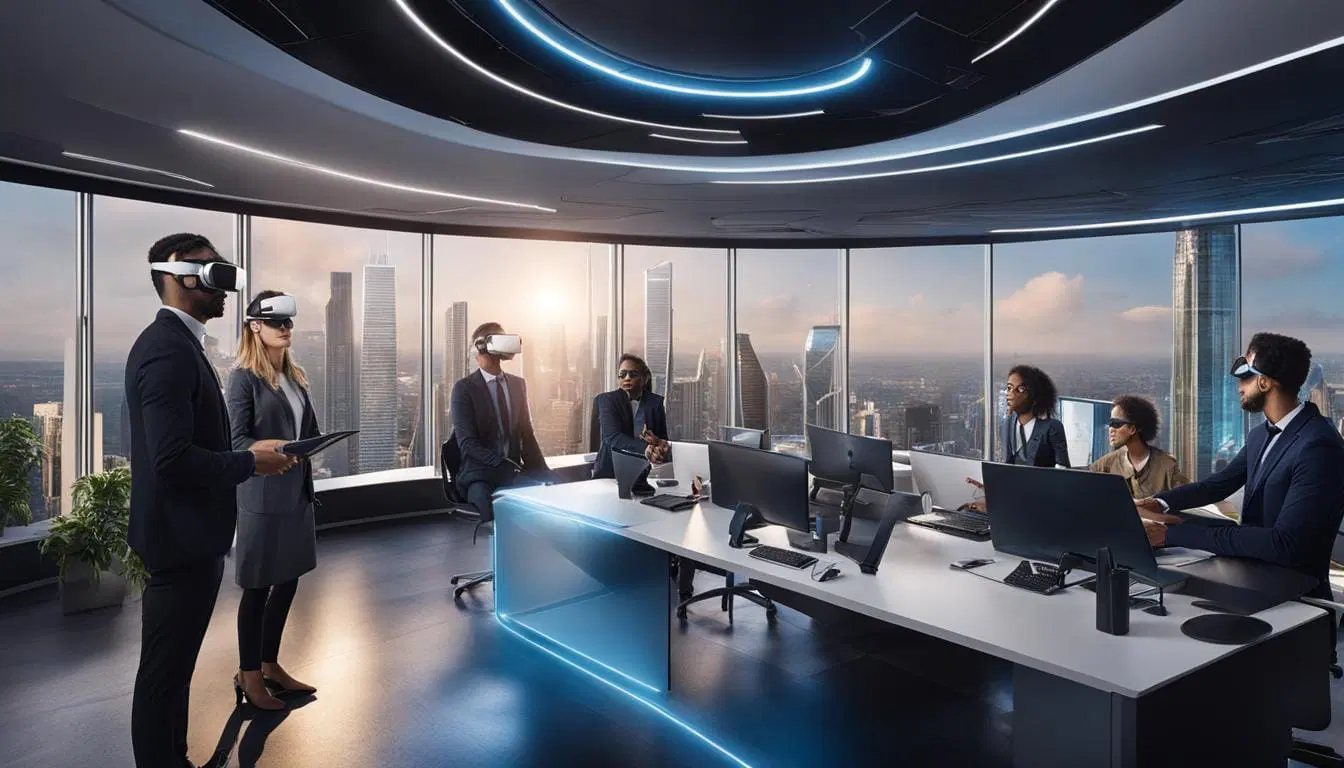
For years, the metaverse was primarily associated with entertainment and virtual gaming, but its potential extends far beyond leisure. Companies across various sectors have begun exploring immersive digital environments to foster new forms of collaboration, training, and customer engagement. This evolution demonstrates how technology is transforming not only the tools used for work but also the way people interact within a professional setting.
The concept of the corporate metaverse entails creating virtual spaces where employees, clients, and partners can meet via avatars and virtual or augmented reality technologies. These environments enable meetings, presentations, training sessions, and simulations to take place in a more interactive manner than traditional communication platforms allow.
A major advantage of this technology is its ability to bring geographically dispersed teams closer together. As companies adopt hybrid and remote work models, immersive digital spaces offer a way to enhance the sense of presence and collaboration among professionals located in different places.
Beyond the workplace, the metaverse is also being used to create new consumer experiences. Brands can develop virtual stores, digital events, and product demonstrations within three-dimensional environments. This interaction fosters a closer connection between companies and their audiences by offering personalized, innovative experiences.
The expansion of digital platforms mirrors this transformative trend. The internet brings together diverse services and experiences for users with varied interests—including specialized environments like 20Bet—all of which are part of the vast online ecosystem that has evolved alongside technological advancements.
Professional education is another sector poised to benefit from the corporate metaverse. Companies can create highly realistic virtual training programs, allowing employees to practice specific scenarios in a safe environment. In the industrial sector, for instance, workers can simulate complex operations before executing them in the real world, thereby reducing risks and increasing efficiency.
Despite these opportunities, the adoption of the metaverse still faces significant challenges. Equipment costs, the need for adequate infrastructure, and user adaptation are factors influencing the growth of this technology. Furthermore, issues regarding privacy and digital security must be considered to ensure trustworthy virtual environments.
With the evolution of virtual reality, artificial intelligence, and connectivity, the corporate metaverse is poised to become an increasingly prevalent tool within organizations. This technology represents a new stage in digital transformation, creating opportunities for companies to innovate, collaborate, and develop experiences that blend the physical world and the virtual universe in an increasingly integrated manner.
